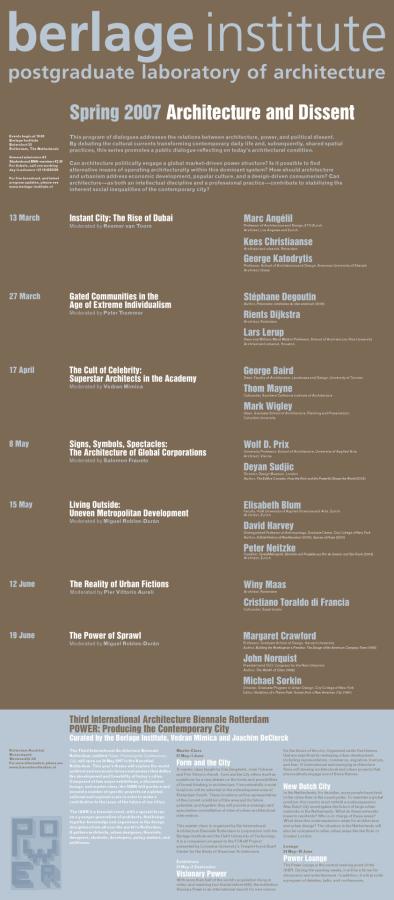
This program of dialogues addresses the relations between architecture, power, and political dissent. By debating the cultural currents transforming contemporary daily life and, subsequently, shared spatial practices, this series of events promotes an open dialogue reflecting on today’s architectural condition.
Can architecture politically engage a global market-driven power structure? Is it possible to find alternative means of operating architecturally within this dominant system? How should architecture and urbanism address economic development, popular culture, and a design-driven consumerism? Does architecture—as both an intellectual discipline and a professional practice—contribute to stabilizing the inherent social inequalities of the contemporary city?
The talks can be viewed by live braodcast, heres the program
Tuesday 13 March
Instant City: The Rise of Dubai
Tuesday 27 March
Gated Communities in the Age of Extreme Individualism
Tuesday 17 April
The Cult of Celebrity: Superstars Architect in the Academy
Tuesday 8 May
Signs, Symbols, Spectacles: The Architecture of Global Corporations
Tuesday 15 May
Living Outside: Uneven Metropolitan Development
Tuesday 12 June
Beyond Degenerate Utopias?
Tuesday 19 June
The Power of Sprawl
Previous mention here on EASA of Berlage Institute was when an attempt was made to widen the discussion in offering further answers to their 6 questions. (109 Provisional Attempts to Address Six Simple and Hard Questions About What Architects Do Today and Where Their Profession Might Go Tomorrow )
A personal response...
(text still being worked on so apologies if the end is messy: like all things : work in progress)
Over the years there has been an evergrowing discussion about what sort of world WE want, what mechanisms we use to find out what type of world that is and from all that what actions we take to make the idea of that world a reality. The WE referred to here is global civil society, or more simply the people of this planet, and not simply the powerful few who presently call the shots which are leading this world to ecological disaster.
In many people´s opinion, there has been a limited involvment from the "architectural community" in this critical act of discussion and action but it seems that things are changing; that they have joined the table and that they have finally started to join OUR discussion. It has to be remembered, of course, that architecture is a very powerful tool and that its control, manipulation and use has been one of the many clever tools or techniques used by the THEM (the powerful few).
Architectural Biennalle Venice 2006: Cities, architecture and society
Last year at the 10th architectural Biennalle in Venice (the architecture olympics, some call it) a truly relevant theme was chosen: Cities, architecture and society. The Bienalle collective are to be commended on choosing this theme, the indepth exploration they carried out, the very well presented exhibition they presented us with and the fine oportunity created for people to engage with this idea, participate in its discussion, take it to the next level...
But there were some criticisms made too of the Bienalle along with some proposals on how it could be improved...
- Participation
- Costs
- Communication
- Seeing the Bienale as a dialogue and not a monologue.
---------- Participation
Firsly who was and who was not invited to participate?
The Bienalle was divided into two parts; the Bienalles exhibition about the theme and individual invited countries responses to the theme. Much of the exhibition focused on human growth patterns, population movement, growing cities, their problems and possible solutions.
Most of these urban shifts are happening in the global south (previously 2nd or 3rd world countries: not Europe, US, Japan and the leading industrial nations of our world) but the odd thing was that although countries in the Global South were being talked about, they had not been invited to participate in the dialogue of what type of world needs to be built, their pavillions were not on show with their ideas or respsones to the biennalles's theme of exploration. It seemed that only about 10% of the nation states of this little planet were represented in national pavillions or by allocated spaces around the city and most of these Nation state exhibitions were of states in the occidental world; predominately European and first world. To add to this, these nation states actually represent far far less of the world population due to their small populations, for example included country Ireland with its 4 million people, compared to that of India with its 1200 million, or thereabouts. Thankfully there were some exceptions, making it not purely a first world affair; Venezuela, perhaps being the most refreshing and memorable response:
“Understand this: our cities are born from a different society. We cannot imitate them. Ours (the third world) is different. It has different roots and another fate. Your recipes, which are the recipes of entertainment, are useless to us. Let us mend our errors our way, and the consequences your outrage. Do not judge us without understanding us. In the future we may even be able to teach you something.”
And what about Los Otros?(the others)
"So who`s here in this funny garden, talking about stuff? what about those who cant get here, who have not been invited, did not have the money, for whom the life didn`t allow them experience "le pur pleasure d`existence" maybe that could be fixed, maybe we could invite them; Cuba, Albania, Sri Lanka, Mali, Kenya, Kibera, Chiapas, Rossport............ "
Some people participating in the residentMETA workshop in the "French" Pavillion METAVILLA (or mets ta vie la, a clever word play translating as PUT YOUR LIFE HERE) decided that this state of exclussion of the majority of the people of this planet from this critical debate was a problem, but that it could be fixed: basically by inviting more people and regions, not just nation states, to participate in the dialogue that was happening. A widening the discussion initiave was begun and for one day a physical temporary Cuban pavilion existed in the giardini. Why Cuba? because Cubans were some of the METAVILLA residents at that time, Lucien Kroll and his friends had just finished their thoroughly enjoyable and perhaps most critical week of discussions that happened at the Bienalle: Moments D`Architectures and that finished by talking about real architectural and urban actions we can take to make our world more ecological, which led to the screening that night in the new Temporary Cuban Pavillion of Power of community, how Cuba survived peak oil. The rest of the places on the above list were not communicated with for their input, but plans are in place to continue the work that was begun in 2006.
Moving from global to local, the attendence and participation of the local Venetians in this big exhibition in their town seemed to be very low. 1895 was the first art Bienale, which simply means bi-annual. From speaking with people it seems that many local people pack up and leave the strange island of Venice while the exhibition is on. They see it as a pricey, exclussive, non imporant event with little or no relationship to them and their lives. The cost of entrance is high and no concessions or open nights were made for the locals, that we are aware of anyway. Again METAVILLA residents felt this was a negative situation so they challenged it; they organised events within the security controlled giardini in which the pavillion exists and invited locals to enter freely, attend and participate in the parties, the discussions, workshops.....
---------- Costs
The ticket for entry was around $15, which was divided into 2 parts, 1 for the arsenale and one for the giardini. The people exploring the Bienalle seemed to be mostly already part of the art/ architecture / urban community, very few non-architectural type people seemed to attend, I wonder if there is interest. Perhaps making the entire event free might change things, or at least having some free open days or a free entry concession for the Venetians..
The findings from the Bienalle are excellent in terms of the depth of their research, but as far as I know, there is no online space to access all this material. Instead the exhibitions accompanying book must be bought and at $145.00 that is just out of the price range of many. Given how important the topic is and what I said earlier about participation I would propose that each public library in the world be given a copy, or more simply that the material could be freely accessible on the biennalle website.
---------- Communication
Another commendable thing at this Biennalle was the introduction of the Venice SuperBlog:
"Venice SuperBlog is broadcast from the Italian Pavilion and acts as a portal between the Biennale and the world. We invite you to explore the website and leave your comments."
"who gets to share their views, who is invited?, are there open spaces for people to share views, are they free, who gets to listen, access to these views.....
the question raised about "architecure, cities and society" is huge and too important to only get discussed by those in the loop, those "professionals", those who others think have the solutions."
At present, it is a closed shop with walls around it which leads to only a fraction of society being bothered about it and its questions or findings. Open it up, make it accessible to all. Make it free and let those who desire otherwise continue to financially assist.
---------- Seeing the Bienale as a dialogue and not a monologue.
the experts came in week 0, before the public, they walked the grounds, they saw the exhibitions, they talked their talk, drank all their wine, and whatever else those specialists do??
after, probably while nursing a hangover, reports were written about the content of the bienalle and they were supposed to do for the extent of the months after, when the public, whoever they are, came and saw, spoke, wondered, criticised, applauded, laughed, loved, hated....
Having lived in METAVILLA for over 3 weeks, having seen all of the exhibition, been at a few events and having spent time talking with people on the doors of many pavillions I think I am in a good position to argue that the Bienalle is, or perhaps should be more of, a dynamic system: an ever widening, roaming, probing, wandering, questioning, ongoing investigation. In short, a dialogue. This was the central raison d'etre of the French Pavillion : "an architectural act is being performed...The welcome of strangers, implacably "other", is more than ever a relevant act.". Its a pity that some of the VSB's professionals didnt stick around to participate in some of the extremely pleasent dialogues that happened over the quarter year of METAVILLA's EXZTence
The wider dialogue...
As a good friend said...
"It is not so much a question of how architectural criticism can serve architecture, but of how architecture may be a medium for critical activity."
in reference to the essay on ctheory.net by Roemer van Toorn : Architecture Against Architecture (Radical Criticism Within Supermodernity)
I would argue that there has recently been an explosion of critical activity which has come about for a few reasons
1 - paradigm shift,
2 - new tek
3 - new mechanisms of organisation and action
leading to a requestioning of exis
So now that the architectural world has started to address the critical dialogue of our time : what must we do to survive here as a species. Perhaps this community, which has so much creativity, ideas and dreams to offer, might participate more with the wider community and together a wider discussion might grow.
having a strong architectural theory which prompts action which often takes the form of interactions in space, which is a type of architecture in its own right, to
So architecture and dissent was what prompted this post, so it is fitting to direct you to the international DISSENT network which are busy preparing for the upcoming meeting of the G8 in Germany
, what could perhaps be described as, the most critical debate the human species needs to address, continually work on and with, and from that have successful sustainable architecture come from (whatever that is, we still need to find out)
Dunk, were you involved in the Dolphin's Barn Community Garden on the banks of the canal?
I'm working on a feasability study for the area and I've seen some coverage of this on the interwebs. Seems like it could be tied into an allotments/gardens in the city typology that we'd like to see more of in Dublin.
"Seems like it could be tied into an allotments/gardens in the city typology that we'd like to see more of in Dublin."
that was what i proposed with the thesis: 18 km eco corridor, greenway and CPUL (continous productive urban landscape) for Dublin, a step city could take to become more of a "sustainable city". and from that bit of "theory" took it to action...
In terms of being invovled with the DB garden: I was indeed hugo. I proposed and organised the initial workshop at a grassroots gathering during thesis year, in which we went to the first garden space, then a derelict field and had a chat with @ 30 people who were interested in the idea, a few days later we entered and planted trees and from that the garden began. more info here : The Irish community gardening experience. In typical sensationalist mainstream media fashion the Times did a "scoop" article in the times about our action, quite misleading and offputting: "Armed with saplings and spades, they strike under cover of dark. Anarchists are ditching street protests for flower power, turning disused city plots into blooming gardens." Irish anarchists sow seeds of flower power.(click on link and zoom to read full article) The "scoop" appeared only 2 days after one of the gardening collective wrote Bringing Nature to Man's Domain on Indymedia.
And if you check my thesis in bolton st library : Catalyst @ Botanic spine. a few people in english ark schools have been checking it out for precedents for green coridors.
heres the garden site, www.dolphinsbarngarden.org and they have just secured a new patch which is legitimate, which means they get to stay there, so this time the trees will grow and grow, so home brew cider and beer parties in the future: yippeee
if you or any of your mates feel like getting your hands dirty give the garden crew a shout, for me it was one of, if not the most positive and enjoyable bits of architectural action i had the pleasure to participate in in Dublin
for more information id direct you to a fine essay i came across while living and working in Torri Superiore eco village in Italy : THE SIGNIFICANCE OF THE GLOBAL ECOVILLAGE MOVEMENT by Ted Trainer, University of N.S.W., Australia. It describes in detail what a sustainable society would look like, how it would organise itself, and what everyday life would be like, and why: less work for money, less need to spend for new goods, less production of new goods, reuse, fix, recycle, create and invent, less roads, more food growing in city, more local self organised democracy,... its the model we are architecturally testing now.
I live in Barcelon now, were im invovled with a greening the city, greenway project here. There is a place Can Masdeu which is one of the most magical places ive ever been in. check out this fine short essay that describes the how and why some projects just rock: Rurbano Revolution
and the very final thing:
At the Venice Bienalle during Lucien Krolls week of moments d'architecture (which i believe was the most important thing to happen during the bienale, but which was missed by the "professionals" who came for the first week only) we introduced to people present at the feedback session Power of community, how Cuba survived peak oil and screened it that night on the temporary Cuban Pavillion. We introduced the film by saying : in many years people will look at this system (the urban agricultural system described in the film) as one of the most seminal architectural pieces, but with far deeper weight than say the "villa savoye" is viewed today by the few.
When the community gardeners met up for the first island meeting in scariff in clare, we screened the film there too, its had many other screenings over the world...
"Last year, in the French Clichy-sous-Bois, we saw riots triggered by a criminal modern architecture." was the part of the passage from the Zeus of hositaltity by René Schérer, which Belgian architect Lucien Kroll choose to use for the poster for the Moments D'architecture workshop he was invited to give at last years architecture bienale by Patrick Bouchain in the french pavillion, METAVILLA
While there was a small amount of EASA discussion on SUMMERSCHOOL BEIRUT about where art, architecture, politics and life crossover: "Take a stand in the political debate and try to influence it. +/ Take a stand in the architectural debate and try to politicise it."
In the wider world scenes similare to last years French riots were being played out around the planet, except on a far wider scale....why?
Recently the G8 international summit happened in Germany and again there was dissent on the streets, including in some places taking of streets, ereceting of baricades, burning and smashing of buildings and violence. Why is this?
Simply, planet is being destroyed for quick exploitation for financial profit (capitalism), living standards of majority of world population are not improving (even though a fairy tale story is being told to say the contrary) and the forces of control of this unjust system are trying to cut back on peoples right and ability to democratically stand up to (and fight against if need be) this system that threathens the existence of our planet and our species.
So what happened, what can be done and what was done this time to stand up and say no?
1 - the international gathering of dissent against g8
2 - the international infopoint network
3 - the international actions that happened in solidarity with those in germany
_________________________________________________________
1 - the international gathering of dissent against g8
The G8 summit has come to an end and the 8 heads of state, along with their tails, have gone back home, and so have thousands of protesters who were there to make sure they don't get what they want so easily. But while the former will continue with their lies and fucked-up policies, so will the latter with their fights and struggles.
As hundreds of G8 delegates arrived in Germany, mass blockades interrupted their reaching the summit's venue in Heiligendamm. Over 10,000 protesters blocked most of the routes leading to Heiligendamm, 'breaching' the no-demonstration zone around the fence. Despite the largest security operation in German history since World War II and almost unprecedented repression, protesters managed to cripple the summit on the streets of Rostock and Heiligendamm. Official G8 organisers were forced to call "Plan B", ferrying summit attendees by boat or helicopter, while many were delayed or returned.
_________________________________________________________
2 - the international infopoint network
A call went out for global infopoint network. Here is report and audio files from Mataro, outside Barcelona about how we can act locally to fight globally:Mataro contra G8: reflections on the last day at the infopoint:Audio file: 40 mins, language: Spanish: OGG|MP3
Call:G8; Call for global infopoint networkIn conjunction to the alternative media material that has already started coming out of Germany about whats going on, We want to encourage the setting up of a network of nodal infopoints outside of the protest area for people in their local area to be able to go to and find out first hand whats going on.
wednesday 6th - friday 8th June 2007In Matero we had 3 days of live connection with Heiligendamm, live screenings of g8-tv, films, live radio, prerecorded radio, a little kafeta/ party here on Friday 8th during which we did a 40 minute audio discussion with people present:
Mataro contra G8: reflections on the last day at the infopoint:Audio file: 40 mins, language: Spanish: OGG|MP3
3 questions1 - What are your reflections after watching films and footage from the G8? 2 - What do you think of the G8?3 - What do you do in your everyday life to change things?
Prior to the G8, a few Australians stopped off at La Fibra and did an audio interview about the G8, why they were going, their impresssions of the Barcelona/Mataro social movements and also stories from their own local resistance to the G20 in Melbourne. Audio: OGG, language: 50 minutes: ratbags enroute to g8on imc-bcn: Audio contra G8 : Mataro infopoint
_________________________________________________________
3 - the international actions that happened in solidarity with those in germany
“There used to be a period in which all of us knew exactly what to do: many of us would write manifestos, declaring what we were doing, and some of us were successful in realising sections of those manifestos. However, as part of the shift in culture…. that belief in manifestos, and that confidence that we knew what to do, have completely collapsed……. A considerable percentage of people in England…would say ‘good riddance', but the absence of utopian drive is perhaps almost as serious as an overdose”
—Rem Koolhaas
If ever there was a time to have strong ideas about how we, human beings living on a finite planet, should live its now. The human species is already in crisis due to its altering of the conditions which have given it the chance to live. The twin challenges of Peak Oil and Climate Change have to be adressed, and although much laughed at or simply dismissed, thankfully the story of humans standing up, thinking critically, using creativity and taking "direct action" to make a difference has opened up a new chapter: the camp for Climate action happened last week in London and saw more than a thousand people coming together to demonstrate a healthier alternative to todays unsustainable world.
-People demonstrated a low impact zero CO2 emissions example of sustainable living, compost toilets, water treatment, tent structures, recycling of all materials...
-People came together with the belief that politicians and corporate groups can not or will not solve our problems, that it is up to normal people to come together, share ideas and skills and take "direct action" for a better world.
-People used horizontal participative direct democracy through consensus for decision making (anarchist method of self organisation).
Its now not only crusty dreadlocked hippys and bonkers scientists who are making noise... now its all types, like you and like me. As camp activist and author Geore Monbiot wrote: "The people who set up the Heathrow climate camp are neat, articulate and frighteningly well-organised. What is the world coming to? "
watch the following YOU TUBE films to get a clearer idea of the camp and the DIRECT ACTION
Climate Camp: Channel 4 News report, 13th August 2007
BBC report of the climate camp outside Heathrow
Climate Camp Heathrow (renewable energy onsite) 15.09.07
summary of the different renewable energy being used at the climate camp. Sharing skills and knowledge of how to survive without mains electricity.
Another End of the World is Possible: Pauline _ Learn
Police 'kettling' about 200 demonstrators to get them out of BAA car park to prevent them joining with other people who are already blockading the road entrance to the BAA HQ.
So what are we saying, simply that climate change is already happening, we are responsible and there is a simpler, saner, healthier, more sustainable way to live. This means building sustainable communities and making the reality grow around the planet untill the time comes when our species are living sustainably. A big ask? yes. Possible? Yes, its the challenge of our time.
Above post "sustainable architecture and urbanism : turning the idea of eco cities into realities, or trying to anyway" refered to actions taken in Dublin and beyond to attempt to respond to the big ask. Again id refer people to THE SIGNIFICANCE OF THE GLOBAL ECOVILLAGE MOVEMENT by Ted Trainer, University of N.S.W., Australia. for an example of what a future sustainable world will look like.
One new idea I heard about at the camp was "Transition Towns": communities that are responding to the twin challenges of Peak Oil and Climate Change. This model seems to be growing widely and quickly in Britain, perhaps it might come to a town near you soon. We still have to fully explore the idea of sustainable cities / Eco cities, which we, EASA, started to explore in Banja Luka, Bosnia 4 years ago and that led to the setting up of the Dublin ECG (eco city group) 2 years ago and from there some things have been growing here in Barcelona
Thankfully the mainstream British media have overall been very fair and given an accurate picture of the climate camp, what we are FOR, how and why we feel the need to take "direct action" and the response by the state: despite our commitment to NVDA (non violent direct action) UK anti-terrorist laws were used, more than 70 people were arrested during the week, extremely heavy handed violent repression, causing a series of injuries to protesters, was used on the day of action to stop people making their way to protest at BAA (British aviation authority / the owners of Heathrow), which flies in the face of peoples democratic right to protest. An example of the excessive use, or abuse of the law was when a 20 year old protester, Cristina Fraser, was arrested for riding a bike and kept for 30 hours in a police station without access to a lawyer and no one knew she was being held...scary.
Meanwhile some other views expressed about contemporary architecture, perhaps others in EASA might fill us in on whats HOT out there in arky land:
The Koolhaas quote from article "Designing the future"
A Brief History of Horizontality: 1968/1969 to 2001/2002:
"The history of the recent world can be bracketed by two unexpected events that shattered the existing order: the uprisings of May 1968 and the destruction of the World Trade Center on 11 September 2002......The Yokohama Terminal points toward a reconsideration of contemporary architecture and its relationship to the city...the most celebrated case of spectacular architecture, the Guggenheim-Bilbao...FOA's Yokohama Terminal announces the emergence of an immaterial age in which we come to reject our frustrated world of objects for programming, much as Archizoom suggested we would a generation ago."
UK Camp for Climate Action Targets Aviation Industry : IMC-ORG www.indymedia.org
----Inside Heathrow's protest camp: A battle to save the world (Independant)
"I discovered they have one purpose: to urge us to listen
to the world's scientists and cut back on our greenhouse gas emissions - before we descend into climate chaos we cannot reverse and may not survive." news.independent.co.uk
----The new face of activism (Guardian)
"The people who set up the Heathrow climate camp are neat, articulate and frighteningly well-organised. What is the world coming to? " commentisfree.guardian.co.uk
more climate camps articles, ideas, vids, audios
New chapter has opened up for the worlds social movements: camp(S) for climate action (IMC-UK) www.indymedia.org.uk
+
Climate Camp, Heathrow (IMC-IE) indymedia.ie
Another End of the World is Possible
is a series of captivating video portraits of people taking radical action against the root causes of climate change. Ranging from an activist who occupied an airport's taxi way, to a teacher working with kids on a deprived housing estate, the portraits demonstrate the wonderful diversity of those taking part in this years Camp for Climate Action in the UK : 14th --21st www.youtube.com